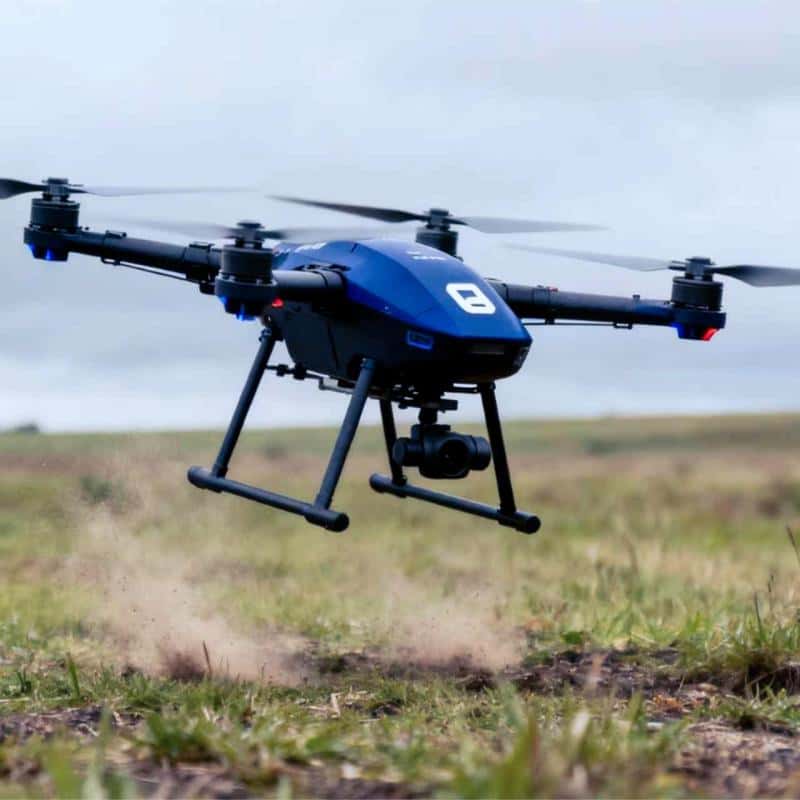
Lightweight Edge AI Compute for Autonomous Drones

Autonomous drones need compact, power-efficient compute for vision perception, navigation, obstacle avoidance, and real-time decision-making. MScape enables onboard AI processing and control for inspection drones, research platforms, and intelligent aerial robotics.
drone edge ai computing module application

The Challenge

Traditional drones depend heavily on remote control and lack full autonomous operation. They often cannot actively identify targets, localize themselves, plan paths, or select inspection viewpoints. Adding high-compute modules can improve intelligence, but also increases power consumption, reduces endurance, and limits operating range. Harsh weather and signal interference further challenge stability and reliability.

MScape Solution Approach

MScape uses the ultra-small and lightweight T40 compute platform to provide onboard embodied intelligence for drones. The platform supports visual recognition, positioning, autonomous task execution, wireless communication, and multi-sensor fusion while keeping size and power consumption suitable for airborne deployment.

1

Onboard Visual Recognition

High-precision visual recognition and localization help drones identify targets, understand the inspection scene, and reduce dependence on manual viewpoint selection.

2

Autonomous Path and Viewpoint Planning

Embodied intelligence task algorithms support the closed loop from mission planning to execution, allowing the drone to choose flight paths and inspection angles based on the actual environment.

3

Communication and Sensor Fusion

Integrated 5G and Wi-Fi communication, combined with multi-sensor fusion, helps the drone sense, analyze, and adjust in complex field environments while maintaining safety and stability.

The Result: Lightweight Onboard Intelligence for Autonomous Flight Tasks

T40 gives drone developers a compact compute foundation for inspection, security, and field robotics scenarios where autonomy, perception, and endurance must be balanced.

T40Ultra-small and lightweight robot-side compute platform
VisionTarget recognition and localization for inspection tasks
5G / Wi-FiHigh-speed wireless communication for mission data
AutonomyMission planning, path planning, and execution loop support
FusionMulti-sensor awareness for complex environments
Airborne FitCompute capability designed around size and power constraints

Why This Matters for Robot Builders

Drone intelligence must be onboard, lightweight, and power-aware. A useful flight platform needs enough perception and task autonomy without sacrificing range, endurance, or reliability in the field.

Key Engineering Requirements Addressed

LightweightDesigned for airborne size and weight constraints
AutonomousSupports task planning and closed-loop execution
PerceptiveAdds visual recognition and localization capability
ReliableSupports operation in complex environments with wireless communication

Building an autonomous drone? Share your payload, flight duration target, camera setup, wireless requirements, and onboard AI workload.

Start Technical Inquiry

Other Applications

wheeled humanoid robot ai computing platform

Wheeled Humanoid Robot Compute Platforms

Wheeled Humanoid Robot Compute Platforms Wheeled humanoid robots combine mobile navigation, upper-body interaction, vision perception, and real-time control in one system. MScape provides robot-side compute ...
Read More →
rugged ai compute for autonomous heavy equipment

Autonomous Excavators

Rugged AI Compute for Autonomous Heavy Equipment Autonomous excavators and heavy machines need reliable compute for perception, positioning, path planning, and hydraulic control in demanding ...
Read More →
bipedal humanoid robots

Bipedal / Humanoid Robots

Bipedal / Humanoid Robot AI Compute & Control Bipedal and humanoid robots need robot-side intelligence that fits inside tight mechanical spaces while still supporting perception, ...
Read More →
Scroll to Top